

How to Create Work-Life Separation at Home: The Definitive Guide to Physical Boundaries
Brought to you by the Workpod team
For millions of Australian professionals, the kitchen table became a desk in 2020 and never quite went back to being just a kitchen table. Working from home offers genuine flexibility, but without deliberate physical and psychological boundaries, the line between professional focus and personal restoration erodes quickly. Research into context-dependent memory suggests that the spaces we inhabit directly shape our mental states — meaning the environment where you work actively affects how well you work, and how well you rest. This guide provides a practical framework for reclaiming that distinction, from understanding the psychology behind physical separation to evaluating the dedicated home office solutions that make it permanent.
Key Takeaways
- Understand why schedules alone are insufficient for genuine work-life separation, and why physical boundaries are the more reliable solution.
- Discover the psychology of the "Third Space" and how architectural cues can help your brain transition between professional and personal modes.
- Compare practical separation strategies suited to Australian homes, from room dividers to backyard office pods.
- Learn how acoustics, lighting, and daily rituals combine to create a workspace that supports focused, high-output work.
- Evaluate the Workpod modular range as a long-term investment in both productivity and residential property value.
Table of Contents
- The Erosion of the Home Sanctuary: Why Mental Boundaries Fail
- The Psychology of the Third Space and the Commute
- Comparing Physical Separation Strategies for Australian Homes
- Designing Your Sanctuary: Rituals, Acoustics, and Light
- Investing in Professional Freedom: The Workpod Solution
The Erosion of the Home Sanctuary: Why Mental Boundaries Fail
The appeal of working from home is real — no commute, greater autonomy, and the comfort of a familiar environment. But without proper structure, the home quickly becomes an extension of the office rather than a refuge from it. The "always-on" trap emerges when digital proximity removes the natural stop signals that an office environment provides. Without a commute to decompress, a building to leave, or colleagues to say goodbye to, many remote workers find themselves checking emails at 9pm not because they want to, but because nothing in their environment is telling them to stop.
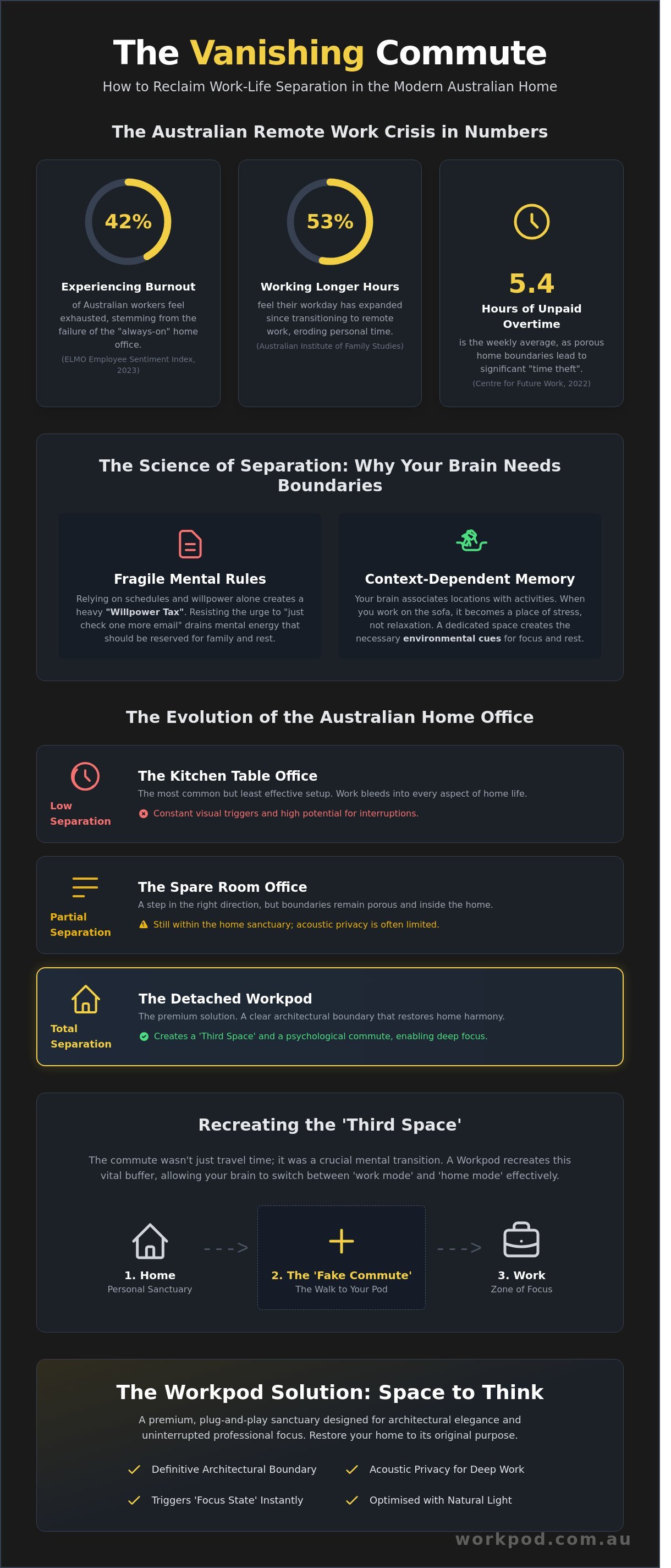
This cognitive fatigue compounds over time. A growing body of workplace research indicates that employees who lack clear boundaries between professional and personal space report higher rates of burnout, lower sleep quality, and reduced satisfaction with both their work and home life. The problem isn't discipline — it's design. When your living room is also your boardroom, your brain has no environmental cue to distinguish between the two states.
The Science of Context-Dependent Memory
Psychologists use the term "context-dependent memory" to describe the way our brains associate specific environments with particular emotional and cognitive states. Studies consistently show that working in the same space where you sleep or relax actively disrupts both — the brain struggles to fully enter a productive work state in a space coded for rest, and equally struggles to decompress in a space coded for work. This is why even a small physical distinction between your work zone and your living zone can have a disproportionate impact on both your focus and your recovery.
Creating distinct work zones leverages these environmental cues deliberately. The goal is to make your workspace feel different enough from your personal space that crossing the threshold between them produces a genuine shift in mental state. This doesn't require a large home or an expensive renovation — but it does require intentionality.
Why Schedules Alone Are Not Enough
Time-blocking and calendar management are useful tools, but they rely on willpower to enforce. The "just one more email" phenomenon is almost universal among home-based workers precisely because no physical barrier exists to make stopping the default. In contrast, a physical boundary — a closed door, a separate room, or a dedicated outdoor studio — makes stopping automatic. You leave the space. Work stays there. In this sense, investing in a dedicated workspace is not a luxury; it's a productivity infrastructure decision that pays dividends every working day.
The Psychology of the Third Space and the Commute
For many professionals, the daily commute served an unacknowledged psychological function — it was a transitional ritual that allowed the brain to shift from home mode to work mode in the morning, and back again in the evening. The loss of this transition is one of the most underappreciated challenges of remote work. Without a commute, many home workers report feeling "already at work" from the moment they wake up, and never quite "off" by the time they go to bed.
The concept of a "Third Space" addresses this directly. A third space is any environment that is neither home nor office — a coffee shop, a library, a garden studio — that serves as a transitional zone between the two roles. For remote workers, creating even a modest version of this transition can meaningfully restore the psychological separation that the commute once provided.
The Threshold Effect
Research in environmental psychology points to what is sometimes called the "doorway effect" — the cognitive shift that occurs when we pass through a physical threshold. Passing through a doorway helps the brain compartmentalise information and role-switch more effectively, reducing the work-related rumination that makes it difficult to fully relax in the evening. In practical terms, this means that a workspace with its own entrance — even a backyard pod accessed via a garden path — provides a more effective psychological boundary than a desk in the corner of the living room, regardless of how well that desk is organised.
Designing a simple transition ritual reinforces this effect further. A brief walk to a dedicated workspace, a change of clothes, or even a consistent morning coffee routine tied to a specific location all serve as reliable signals to the brain that a role shift is underway. These rituals don't need to be elaborate — consistency is what makes them effective.
Architectural Cues for Professional Dignity
Beyond rituals, the physical design of a workspace sends powerful signals to both the occupant and others in the household. A dedicated entrance, purpose-built furniture, and controlled lighting all communicate that this is a professional environment — reinforcing the psychological separation between work and home life. For households with children or shared living arrangements, these architectural cues also help set expectations. When family members can see a closed door or a separate structure, the visual boundary communicates "work is happening" far more effectively than a calendar notification or a verbal request for quiet.
In addition, the quality of the workspace itself affects self-perception and output. Research in environmental psychology consistently shows that people perform more professionally in environments that feel professional. A thoughtfully designed, dedicated workspace doesn't just reduce distraction — it actively elevates the standard of work produced within it.
Comparing Physical Separation Strategies for Australian Homes
Australian homes offer a range of options for creating dedicated work zones, from simple internal arrangements to purpose-built outdoor studios. The right solution depends on your available space, budget, lease conditions, and the nature of your work.
Maximising Vertical and Garden Space
For apartment dwellers or those in open-plan homes, vertical space and room-dividing solutions can create a functional work zone without requiring a separate room. The Paxton and Cube Room-In-Room collections provides a self-contained acoustic environment within an existing floor plan, creating a genuine room-within-a-room that requires no structural modification to the building. This makes it particularly well suited to renters or those in leased office spaces, where permanent alterations are not permitted or financially viable.
For homeowners with access to a backyard or garden — and approximately 60% of Australian residential properties include outdoor space — a dedicated outdoor studio offers the most complete form of work-life separation available. The physical act of walking to a separate structure, entering a distinct space, and closing a soundproof door behind you engages all of the psychological mechanisms discussed above simultaneously.
The Modular Advantage
Modular office pods represent the most practical and cost-effective route to complete physical separation for most Australian professionals. Unlike traditional home extensions, which can cost upwards of A$50,000 and require months of construction, a premium modular pod delivers a fully equipped, acoustically engineered workspace in a matter of days. Furthermore, because modular pods are classified as furniture or non-habitable structures rather than permanent additions, they typically don't require council permits under exempt development rules in most Australian states — making them a genuinely accessible option for a wide range of properties.
The modular advantage extends beyond installation. When you move house or change office, the pod moves with you rather than being left behind as a sunk cost in a landlord's property. For more details on the logistics, explore Workpod's shipping and setup information.
Designing Your Sanctuary: Rituals, Acoustics, and Light
Physical separation is the foundation, but the internal design of your workspace determines how effectively it supports focused, high-output work. Three elements matter most: acoustics, lighting, and the rituals that bookend your workday.
Acoustic Engineering as a Boundary
Household noise — a partner on a call, a neighbour's lawn mower, the ambient hum of a busy street — is one of the most persistent threats to home-based productivity. Research shows that unpredictable noise elevates cortisol levels and directly impairs cognitive performance, even when the noise is below the threshold that most people consciously notice. In contrast, a consistent, low-level acoustic environment allows the brain to settle into a focused state more quickly and maintain it for longer.
Double glazing and high-density wall insulation are the most effective acoustic tools available in a dedicated workspace. A sound reduction of 30 decibels transforms a 75dB suburban environment into a library-quiet zone where concentration becomes the default rather than a constant effort. For urban Australian homes where noise from neighbours, traffic, or shared walls is a persistent challenge, this level of acoustic engineering is particularly valuable. See the Prescot, Piper or Padstow Pod for a practical example of how this is achieved in a backyard studio context.
The Visual "Off" Switch
The visual environment of your workspace matters during working hours, but what you see after hours matters equally. Research in behavioural design consistently shows that visible work cues — an open laptop, a stack of documents, a whiteboard covered in notes — prime the brain for work mode even when you're trying to relax. In a dedicated external workspace, this problem solves itself: you close the door, and the visual cues disappear entirely. For internal work zones, adopting a "clean desk" ritual at the end of each day — putting equipment away, closing notebooks, and removing work materials from view — serves the same function and signals to the brain that the workday has concluded.
Colour psychology can also support this transition. Warm, lower-intensity lighting in the evening signals the brain to begin winding down, while cool, bright lighting during work hours supports alertness and concentration. Workspaces with dimmable lighting allow you to use the same space across different energy states and to control the transition between them deliberately.
Investing in Professional Freedom: The Workpod Solution
Investing in a dedicated home workspace is ultimately an investment in both your professional performance and your personal wellbeing. The two are not separate considerations — a workspace that enables genuine focus during work hours is what makes genuine rest during personal hours possible. For Australian professionals seeking a permanent, high-quality solution to work-life separation, the Workpod modular range offers a scalable answer across a variety of spatial contexts.
The Paxton Collection: Indoor Space to Think
The Paxton collection provides a versatile indoor solution for corporate offices, open-plan workplaces, and home environments with sufficient ceiling height. Available in Large, Medium, Small Wide, and Small configurations, the Paxton range is engineered for rapid assembly and can be operational within hours of delivery. Its aerospace-grade aluminium frame, double-glazed tempered glass panels, and whisper-quiet ventilation system create a professional acoustic environment within any existing floor plan — without requiring structural modification or council approval.
Compact Solutions for Tight Spaces
For urban backyards and smaller residential blocks, the Pymble Pod offers dedicated outdoor workspaces in compact footprints. The Pymble, at just 4.6m², is specifically engineered for the high-density suburban landscapes common across Sydney and Melbourne inner suburbs, fitting comfortably into spaces where a larger structure would not. Available in two styles, the Pymble arrives as an organised flat-pack, can be assembled without professional trade support, and connect to a standard household power outlet for immediate use.
Ready to create genuine work-life separation? Explore the full Workpod range and find the solution that fits your home and your working style.
Frequently Asked Questions
How do I create work-life separation in a small apartment?
In a small apartment, the key is creating visual and acoustic distinction within the available space rather than seeking complete physical separation. Consider using a room divider, a dedicated corner with distinct lighting, or a modular indoor pod like the Cube Room-In-Room to create a functional work zone that feels different from the rest of your living space. Establishing a consistent end-of-day ritual — tidying your desk, closing your laptop, and physically leaving the work zone — helps reinforce the psychological boundary even in a compact environment.
Does an outdoor office pod require a council permit in Australia?
In most Australian states, a modular outdoor pod under 10 square metres does not require a council permit and qualifies as exempt development. NSW regulations allow structures up to 20 square metres under exempt development rules, while Victoria typically sets the threshold at 10 square metres. You should always verify the specific requirements with your local council, particularly if your property is in a heritage conservation area or bushfire-prone zone, as standard exemptions may not apply in those cases.
What is the most effective ritual to switch off from work at home?
The most effective end-of-day rituals are those that engage both a physical action and a spatial transition. Walking away from a dedicated workspace — ideally one with its own entrance — and performing a brief decompression activity such as a short walk, a change of clothes, or preparing a meal signals to the brain that the workday has ended. Consistency is more important than the ritual itself. Performing the same sequence of actions at the same time each day trains the brain to associate that sequence with the transition from professional to personal mode.
Is it better to work in a spare bedroom or an outdoor pod?
An outdoor pod offers a more complete form of work-life separation than a spare bedroom, primarily because it requires a physical journey between spaces — engaging the threshold effect discussed earlier in this guide. A spare bedroom also shares walls, heating, and ambient noise with the rest of the home, making genuine acoustic privacy difficult to achieve without significant investment. In contrast, a purpose-built outdoor pod provides acoustic insulation, a dedicated entrance, and a visually distinct environment that all reinforce the psychological boundary between work and home life. For those without access to outdoor space, a high-quality indoor pod solution such as the Cube Room-In-Room is the next best alternative.
How can I stop family members from interrupting my work hours?
The most reliable solution is a combination of physical boundaries and communicated expectations. A dedicated workspace with a closable door — whether an outdoor pod or an internal room — provides the visual signal that interruptions are not welcome, which is more effective than a verbal request alone. Establishing a shared household routine that aligns with your core work hours, and using simple visual cues such as a "do not disturb" indicator on your workspace door, helps family members understand when focus time is in effect. For households with young children, the physical separation of an outdoor workspace is particularly effective, as it removes the temptation to interact entirely.
What is the minimum space needed for a dedicated home office pod?
The Pymble model from Workpod requires a footprint of just 2.15m x 2.15m — approximately 4.6 square metres — making it viable for even compact urban backyards. This footprint comfortably accommodates a full-height desk, a monitor setup, storage, and adequate space to move freely. For those who host occasional client meetings or require a larger working area, the Prescot Small at 6.6 square metres provides a more spacious environment while still qualifying for exempt development in most Australian states. Always measure your available space and account for the recommended 900mm setback from boundary fences before selecting a model.
Can a home office pod increase my property value?
A premium, purpose-built outdoor workspace is increasingly recognised by Australian property buyers as a desirable feature, particularly as hybrid working becomes a permanent fixture of professional life. Real estate research suggests that a high-quality dedicated home office can meaningfully increase residential property value, with the appeal strongest in competitive city markets where buyers are actively seeking properties suited to remote work. In addition to resale value, a Workpod qualifies as a depreciating asset under ATO guidelines for business owners using it exclusively for income-generating purposes. Always consult your accountant for advice specific to your circumstances. Similarly, equipping your new office with the right digital infrastructure is crucial for success. For those running businesses with physical products, Australian-owned systems like Peach Software provide the cloud-based tools needed to manage inventory and operations from a dedicated home workspace.
How long does it take to set up a Workpod outdoor studio?
Most outdoor Workpod models can be assembled by two to three people in three to four days from delivery, with the compact Pymble achievable as a DIY project in less time. Each unit arrives as an organised flat-pack with a comprehensive installation guide and all necessary hardware. Once assembled, connection to a standard household power outlet activates the integrated electrical system, lighting, and ventilation — making the workspace fully operational within the same week as delivery, without the months of disruption associated with traditional construction.
This article was written by the Workpod Team. Workpod is a 100% Australian owned online only provider of indoor and outdoor modular workspaces, based in Sydney delivering Australia wide. Our mission is to help customers large and small make the most of limited space to work better, inside and out.
Content Disclaimer
The information in this article is general in nature and is intended for informational purposes only. While it has been written to the best of our ability at the time of publication, we do not warrant the accuracy of all the information therein. You should not consider this professional, legal, financial, or regulatory advice. Workpod recommends you consult a suitably qualified professional before making any Tax, financial or Council related decisions.